


|
Do triarchic model of grit dimensions predict subsequent achievement goals, math and science engagement, and well-being outcomes among children in Hong Kong and Macau? (Jan 2024 – Dec 2026, Project No.: 18609923) Principal Investigator About the Project |
|
|
The Affordance of an Emotionally Safe Translanguaging Space for Supporting Hong Kong Ethnic Minority Students in Managing Second Language Classroom Anxiety: A Study of Chinese as an Additional Language Classrooms (Sep 2023 – Aug 2025, Project No.: 27616923) Principal Investigator Abstract Nevertheless, studies examining how teachers can create a positive classroom atmosphere to alleviate students’ L2 classroom anxiety are lacking. This project proposes a mixed-methods, multi-site approach and adopts translanguaging — the exploitation of multiple linguistic, semiotic and sociocultural resources in multilinguals’ repertoires to facilitate knowledge construction and empowerment — as an analytical perspective. The project aims to investigate how emotionally safe translanguaging spaces can be created to alleviate EM students’ anxiety in learning CAL.
Quantitatively, the study will employ a questionnaire to identify EM students’ L2 classroom anxiety levels. Semi-structured interviews, video-recorded classroom interactions and videostimulated recall interviews will provide qualitative insights on: (1) the individual and situational factors the EM students associated with anxiety and how they experience anxiety in learning CAL, (2) how teachers can construct translanguaging spaces to minimise students’ CAL-learning anxiety, and (3) how teachers and students make sense of translanguaging practices in CAL classrooms. The classroom interactional data will be analysed using Multimodal Conversation Analysis. The data will then be triangulated with the video-stimulated recall interviews to which Interpretative Phenomenological Analysis will be applied to investigate teachers’ and students’ reflections on translanguaging practices in CAL classrooms. The findings will provide important insights into students’ experiences of a translanguaging space intended to create a positive classroom atmosphere for CAL learning. These insights will allow development of sustainable pedagogical approaches for pre- and in-service teachers allowing them to tap into students’ diverse linguistic and cultural knowledge to alleviate their CAL-learning anxiety.
|
|
| Project on Enhancing Learning Experience for Students with Visual Impairment in Higher Education (2019 – 2022)
Principal Investigator About the Project |
|
| Jockey Club “Play n Gain” Project (Sep 2018 – Feb 2022)
PI: Professor YUEN, Man Tak, Faculty of Education, The University of Hong Kong Funded by Project Objectives
|
|
| Development of the Special Education Curriculum Guide in Macao (2016-2019)
Principal Investigator Project Objectives
|
|
| Research Study to Develop and Evaluate a Model for Life Planning for SEN Students in Form1-Form 3, 2016-19
Principal Investigator Commissioned by More details of the Press Conference and Forum for the “TWGHs Sun Life Navigation Project Research Result Announcement” (available in Chinese only) |
|
| A Cognitive-linguistic Approach to Tiered Writing Intervention for Students with Diverse Learning Needs in Senior Primary Schools 2015-17
Principal investigator |
|
| Systematic Approach to Mainstream Education (SAME) Curriculum Project (2006-present) (PI: Andrew Tse; & SAME Curriculum Project schools; Self-funded and self-sustained) The SAME Project was initiated by CAISE in collaboration with several special schools in 2006, as a response to the “one curriculum for all” principle put forward by the Curriculum Development Council. The main objective is to develop an approach to curriculum implementation that enables students with severe and profound learning difficulties to access the mainstream curriculum. Initially nine schools joined the joint school network for school improvement. The project is self-funded with participants subscribing annual joining fees to cover expenses. In six years the team produced a series of curriculum guide supplements for all eight Key Learning Areas (KLAs) with attainment levels for each strand covering the ability range of pupils with mild, moderate and severe intellectual disability. In addition the team also produced an Assessment Package called SCALE for schools to assess pupils objectively at the end of the school year. In 2013, 13 special schools participate in the SAME Project, with over half using the mainstream curriculum framework and units to plan their lessons. |
|
| “No Play No Gain” Kindergarten Social Emotional Learning Project 2016-17
Principal Investigator: Professor YUEN, Man Tak Project Objectives
|
|
| SAME E-enhanced Teaching, Learning and Assessment System (SELTAS) (2010-present) Principal Investigator Mr. TSE, Andrew C. Y. 10 SAME Curriculum Project schools Funded by Education Bureau About the Project In 2010, the HK Education Bureau launched an E-Learning Pilot Project, and invited schools to apply for funding to promote E-learning. The ten SAME Network schools saw this as a golden opportunity to build an Electronic Platform for teachers to share planning materials and resources. The proposal for building an E-learning System called SELTAS was accepted, and the ten schools were given funding to carry out the project. The project team has produced the prototype for the system, and schools are trying out the design and functions for effective teaching and learning. The Project is due to be completed by August 2014. 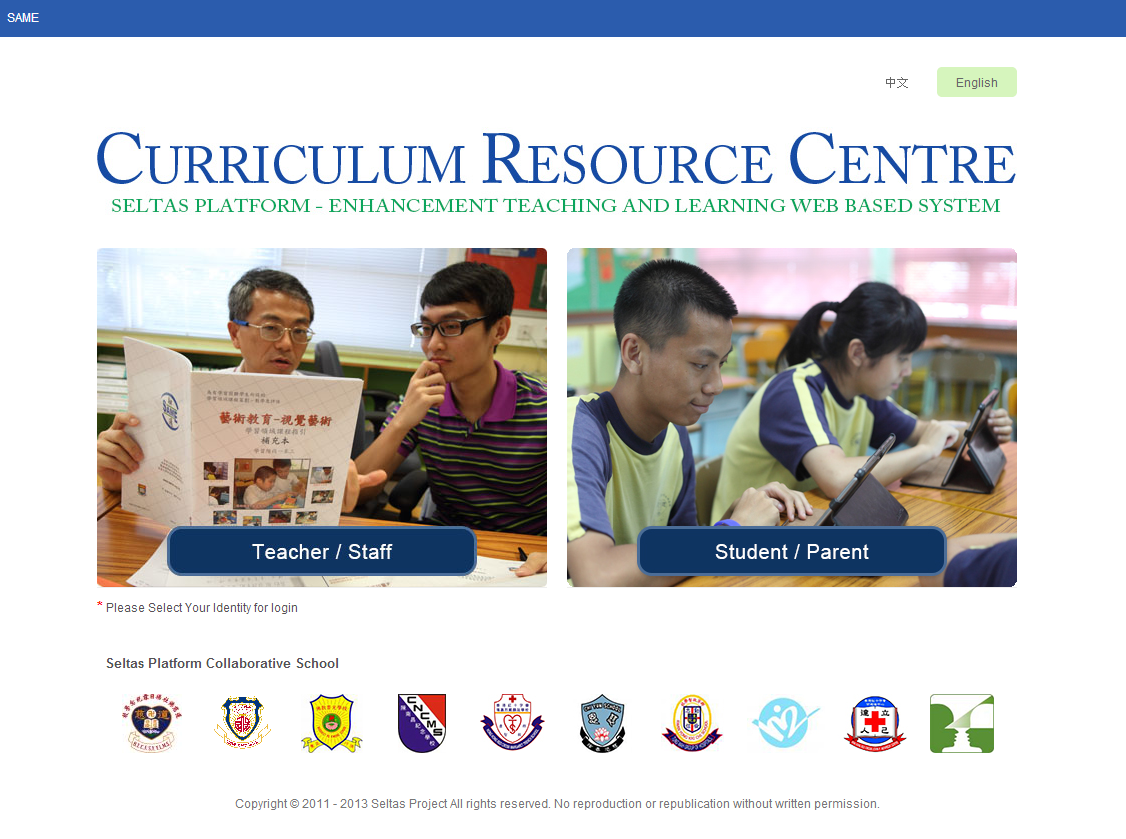 |
|
| Promoting Inclusion through Drama (Co-ordinator: Elsa Ling; Collaboration with The Rock Foundation, The Absolutely Fabulous Theatre Connection Co (AFTEC), HKU Drama Society and Jockey Club Sarah Roe School; Supported by the Centre of Development and Resources for Students (CEDARS) HKU 81 Inclusion Fund) The project aimed to promote social inclusion and to cultivate interest in performance arts for students with special needs. Six students with special needs and two University students worked together to perform a drama show on 25 June, 2012. The show received positive responses from different stakeholders i.e. audiences, participants, parents and school. This project is like a seed planted in the community. It initiates the idea of integrated drama programme and motivates The Rock Foundation to run similar programmes in future.  |
|
| Overcoming Obstacles Associated with Other Learning Experiences and School-based Assessment: Perspectives of High School Students with Visual Impairment in Hong Kong (PI; Mantak Yuen; Co-Is: Jason Ho, Stella Ho, Scarlette Cheng, Chi Wun Chiu, Jonathan Ho, Ricci Fong, YB Chung, Diana Kwok, Carl Cheng, Joe Tsui, Filiz Polat, Jenny Yuen, and Virginia Cheung; Collaborative Research Project of HKU Centre for Advancement in Inclusive and Special Education and Hong Kong Blind Union; Marden Seed Grant) Twenty-five participants were interviewed, based on a structured questionnaire. They were asked to describe all the obstacles they have encountered in school-based assessment and other learning experiences (OLE). They were also asked to suggest how teachers could minimize their difficulties and help them cope with obstacles. It was found that most participants encountered difficulties in OLE. Problems were specifically related to community service, aesthetic development and physical development. School-based assessments also presented difficulties, particularly in three compulsory subjects (Chinese Language, English Language, Liberal Studies) and the elective subjects of humanities. Suggestions are made related to increasing and improving training for teachers, making Braille / soft copies of reading materials available earlier, and strengthening the resource teacher support programme. The report of the study is available on request. Email: caise@hku.hk |
|
| Empowerment Programme for Parents of Children with Special Needs (Coordinator: Maria Wong; Self-funded and sustained) In April 2013 CAISE initiated an empowerment programme for parents of children with special needs. The first workshop (dealing with curriculum) was titled “Growing up together with children”. The purpose was to nurture parents’ understanding of how schools build up a holistic learning environment for children with different needs and abilities. This environment helps develop knowledge, skills and attitudes, as well as providing life experience for the children. |
|
| Cognitive Linguistic Skills Important to Chinese Text Writing among Beginning Writers (PI: Patcy Yeung; Supported by Seed Funding Programme for Basic Research) The first phase of data collection has been conducted. 85 participants in Grade 2, Grade 4 and Grade 6 were administered measures of written composition and cognitive-linguistic skills (including rapid naming, verbal working memory, orthographic-motor skills, transcription skills, oral narrative skills, and syntactic skills). Preliminary findings suggested that orthographic-motor skills and transcription skills were important correlates of written composition beyond Grade 2, and that working memory and oral narrative skills only played a more important role in writing development in Grade 6. A paper on this study was accepted by the 2013 Society for the Scientific Study of Reading Conference. |
|
| Positive Youth Development and Problem Behaviour among Chinese Early Adolescents in Hong Kong (PI: Rachel Sun; Supported by Seed Funding Programme for Basic Research) The purpose of this research is to examine the impact of ‘positive youth development’ on problem behaviour (indexed by school behaviour problems, delinquency, substance abuse and internet addiction), with ‘life satisfaction’ as a mediator among Chinese early adolescents in Hong Kong. A quantitative study was carried out with over 1,000 junior-secondary school students. The findings throw light on the incorporation of positive youth development elements and life contentment into developmental guidance or whole-person development in secondary schools. |
|
| Life Skills Development in Junior Secondary Students: Influence of Purpose, Connectedness and Comprehensive Guidance Programs (PI: Mantak Yuen; Co-Is: Raymond M.C. Chan, Patrick S. Y. Lau, Norman C. Gysbers, and Peter M.K. Shea: Supported by Hong Kong Research Grant Council General Research Fund) The study begins with a qualitative phase to generate concepts and to refine questionnaire items for the large-scale surveys using junior secondary students. Focus group interviews with students and teachers will be conducted in three secondary schools. To ensure a good cross-section of schools with students of various abilities and socioeconomic status in the main study, we will include approximately 80 schools with about 11,200 students and 640 teachers. Approximately 100 students from Grade 7 and 100 from Grade 9 will be questioned about their academic, personal-social, and other life skills, their connectedness to teachers, peers and parents, their purpose in life, and their perceptions of the implementation of guidance programs in their schools. Eight teachers in each school will also complete a questionnaire on the implementation of guidance programs in their school. Students and their teachers will then complete similar surveys 12 months later to assess the longitudinal influences of connectedness, purpose and guidance programs on life skills development. For details, please refer to project webpage. http://web.hku.hk/~life/ |